About KLASTER+
The full title of the project is:
“Energy communities of the future – an innovative system for integrating local renewable energy sources (RES) to reduce energy poverty and support community engagement.”
The story behind the KLASTER+ project
👉 Read the post: The Origins of the KLASTER+ Team and Project.
The project addresses one of the key challenges in today’s energy sector: integrating local renewable energy sources into distribution networks safely and efficiently.
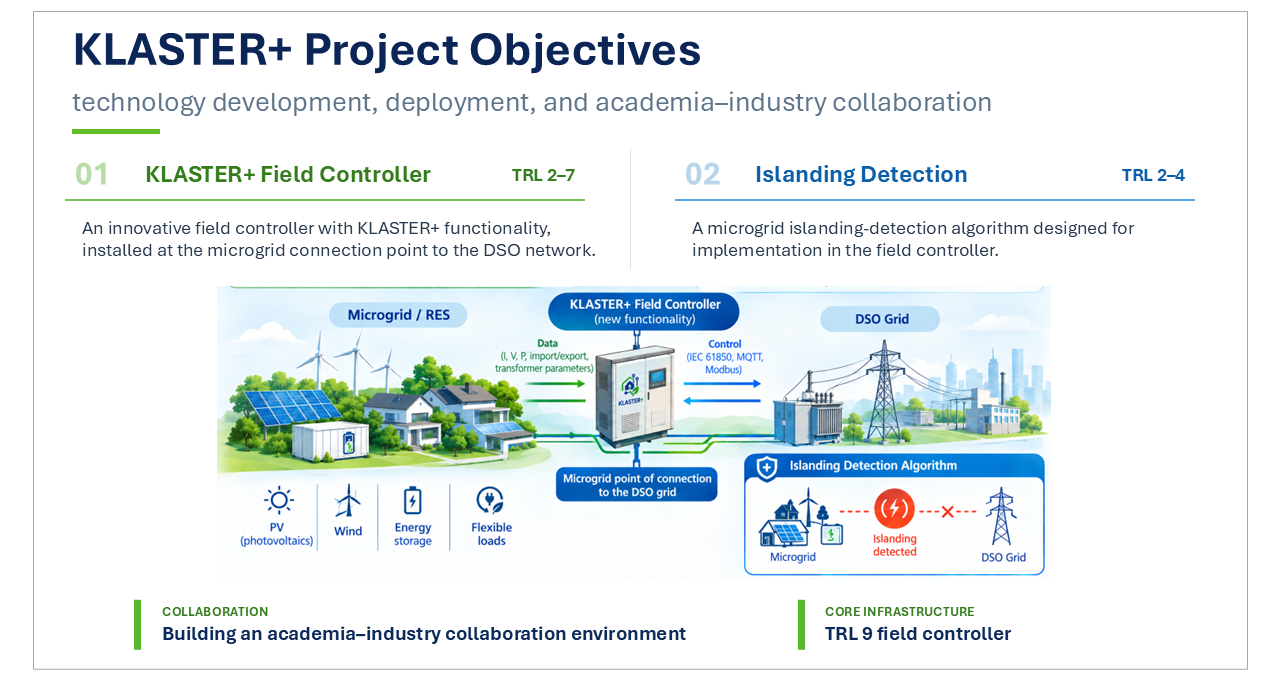 Fig. 1 KLASTER+ project objectives.
Project in numbers
- 36 months of implementation,
- 7 project team members,
- 4 technical and infrastructure partners,
- project budget: PLN 1,999,757.15,
- demonstration of the main solution at TRL 7.
The challenge
Microgrids integrate local renewable energy sources, energy storage systems, and consumers. However, variable generation from solar and wind can make it difficult to maintain the required grid operating parameters.
If operating limits are exceeded, the distribution system operator (DSO) may curtail renewable generation or disconnect renewable energy sources and, in some cases, the entire microgrid. This leaves locally available energy unused and reduces the economic viability of renewable energy investments.
Addressing this challenge requires continuous data exchange between the microgrid and the DSO, together with coordinated control of energy generation, storage, and consumption.
Main project objective
The main objective is to develop, test, and deploy a field controller with the new KLASTER+ functionality. The controller will be installed at the point where the microgrid connects to the DSO network.
The KLASTER+ functionality will enable communication between the microgrid management system and the DSO’s system. Combined with microgrid control algorithms, including a zero-export mechanism, it will coordinate renewable energy sources, energy storage systems, and loads.
The planned functions include:
- monitoring operating conditions at the point of connection,
- exchanging data with the microgrid management system and the DSO’s network management system,
- maintaining power flows within the required limits,
- increasing the self-consumption of locally generated energy,
- reducing the need to curtail renewable generation,
- supporting safe interaction between the microgrid and the distribution network.
The prototype will be tested in the laboratory, verified using Hardware-in-the-Loop (HIL) technology, and then demonstrated in a real-world operating environment. The target technology readiness level is TRL 7.
Additional project objective
An additional objective is to develop a concept for an algorithm to detect islanded operation in a microgrid. The algorithm is intended for future use in field controllers installed at points where microgrids connect to distribution networks.
Within the project, the solution will be developed and initially validated in the laboratory to TRL 4.
Scope of work
The project includes:
- analysis of real-world energy data and selection of a reference site;
- development of microgrid simulation models in DIgSILENT PowerFactory;
- analysis of the interaction between renewable energy sources, energy storage systems, and loads;
- development of microgrid control methods and algorithms;
- definition of functional and technical requirements for the field controller;
- implementation of the KLASTER+ functionality in the controller prototype;
- laboratory and Hardware-in-the-Loop testing;
- integration of the solution with existing energy infrastructure;
- preparation of the solution for further deployment and commercialization;
- sharing project results with scientific, industrial, and public audiences.
Project significance
The project combines scientific research with practical implementation. Its results will support the development of microgrids, energy clusters, and local energy communities.
Better use of locally generated energy can reduce energy costs, improve energy security, and strengthen the resilience of local grids. The project also includes educational and outreach activities to raise awareness of distributed energy and the benefits of renewable energy sources.
Funding
The project is financed from the State budget, with funding granted by the Minister of Science and Higher Education under the “Science for the Development of Society” program. Project No. NdRS/SP/0189/2025/01; total project value: PLN 1,999,757.15.
More information
👉 Project and news: klaster-plus.pw.edu.pl.
🔔 Newsletter: sign up here – we only send notifications about new posts.
📌 Project contact: Tadeusz Daszczyński, PhD Eng. – LinkedIn