Origins of the KLASTER+ Team and Project
From the first idea and formation of the KLASTER+ Team to securing funding and launching the project.
The idea to form a team and prepare a funding application for the KLASTER+ project first emerged on 3 June 2025, in an email from Tadeusz Daszczyński, PhD, titled “I have an idea!”:
Gentlemen,
I have some experience in preparing and managing grants funded by the Ministry of Science and Higher Education, so I am sending you an interesting call. Maybe we can come up with something together?
This email marked the beginning of the joint work on the project concept, which was later submitted and awarded funding under the Ministry of Science and Higher Education programme “Nauka dla Rozwoju Społeczeństwa” (“Science for the Development of Society”).
From the Electrical Apparatus Team to the KLASTER+ Team
The KLASTER+ Team was built on the experience of the Electrical Apparatus Team, which had been active for many years at the Faculty of Electrical Engineering. Its work covered research and development projects, industry collaboration, laboratory testing, and modelling. Over the previous six years, the Team had secured PLN 7 million in funding through research grants, implementation projects, and R&D projects carried out with industrial partners.
The Electrical Apparatus Team consisted of Tadeusz Daszczyński, PhD, Marcin Szewczyk, DSc, Szymon Stoczko, PhD, and Kamil Przygoda, MSc, a doctoral student at the Warsaw University of Technology Doctoral School.
The Team’s track record included numerous papers published in leading international journals as well as patents, including international patents developed in cooperation with industrial partners. At the same time, its research infrastructure was expanded with specialist laboratory equipment and computing resources worth several hundred thousand PLN.
As the KLASTER+ concept took shape, the Team was expanded with expertise in power systems, microgrids, and renewable energy, brought in by Michał Połecki, MSc, and Łukasz Rokicki, PhD, as well as expertise in ICT infrastructure, represented by Robert Wójtowicz, PhD.
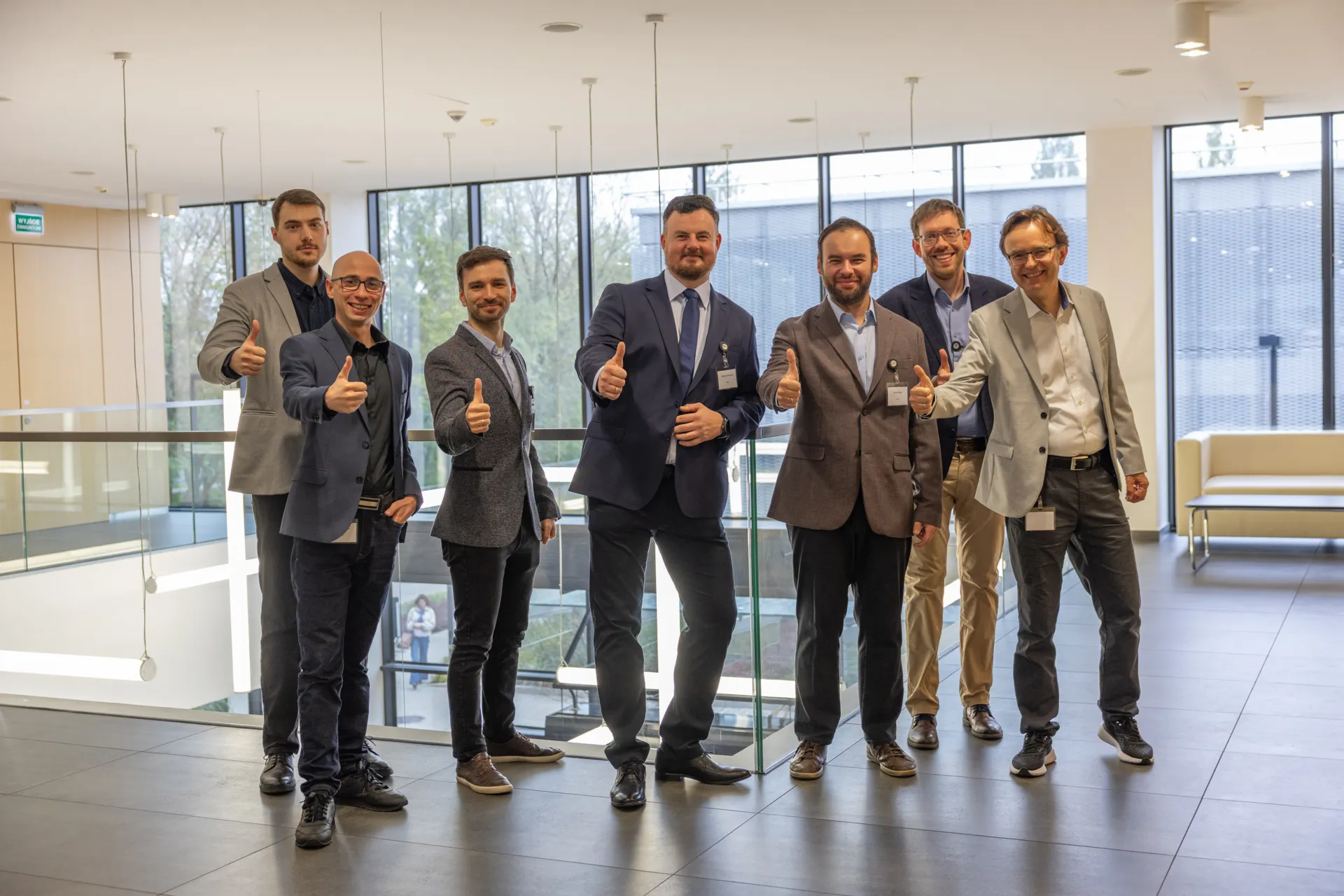 The KLASTER+ Team.
The KLASTER+ project concept
Over the following months, the initial idea developed into a concrete research and implementation concept. It was shaped through a series of meetings with prospective industrial partners and companies from the power sector.
The main technical objective became the development and implementation of a new functionality for a field controller located at the point where a renewable-energy microgrid connects to the DSO distribution network.
In parallel, the cooperation model with project partners was refined, project tasks and milestones were defined, and the demonstration environment was planned.
Internal preselection at Warsaw University of Technology
Before the proposal could be submitted to the ministerial call, it first had to pass an internal preselection process at Warsaw University of Technology.
The Team prepared a presentation, and on 18 October 2025 Tadeusz Daszczyński, PhD, presented the project to a university committee chaired by Prof. Mariusz Malinowski, Vice-Rector for Research.
The project was assessed in three areas and received 35.4 out of 40 points, including:
- 14.5/17 for scientific value and overall merit,
- 15.3/17 for social responsibility of science,
- 5.6/6 for the applicant’s potential.
Seven projects were submitted to the internal preselection at Warsaw University of Technology. KLASTER+ was one of the two selected for submission to the ministerial call.
From preselection to proposal submission
After the preselection stage, work began on the full project proposal. Over the following months, the project structure, scope of tasks, responsibilities, schedule, and cooperation with partners were further developed.
Participation in the programme required the involvement of at least one partner from the socio-economic environment. The KLASTER+ Team secured four letters of intent from industrial partners — more than could be accommodated in the standard OSF application form, the system used to handle research funding applications.
The proposal was submitted to the Ministry on 2 December 2025.
Call results and project funding
The call results were announced on 6 May 2026. KLASTER+ was selected for funding from the state budget by the Minister of Science and Higher Education under the “Nauka dla Rozwoju Społeczeństwa” programme.
The proposal received 34 out of 40 points. It received the maximum score in 7 of the 12 assessment criteria, including the relevance of the planned tasks, clear and measurable project outcomes, the organisational capacity of the applicant and its partners, and the planned dissemination of results. The project also received the maximum 6/6 points in the entire area covering the Team’s organisational capacity and competences.
Project no.: NdRS/SP/0189/2025/01
Total project value: PLN 1,999,757.15
KLASTER+ as the Team’s first joint project
Once funding had been secured, implementation of the KLASTER+ project began.
The joint work resulted not only in the project itself, but also in the creation of the KLASTER+ Team. The Team brings together the competences and experience needed to pursue the project’s ambitious goals.
We are open to new challenges, and each successive KLASTER+ objective will be not only a measure of our effectiveness, but also another stage in the Team’s development — strengthening its competences, cooperation, and ability to deliver increasingly ambitious research and development projects.